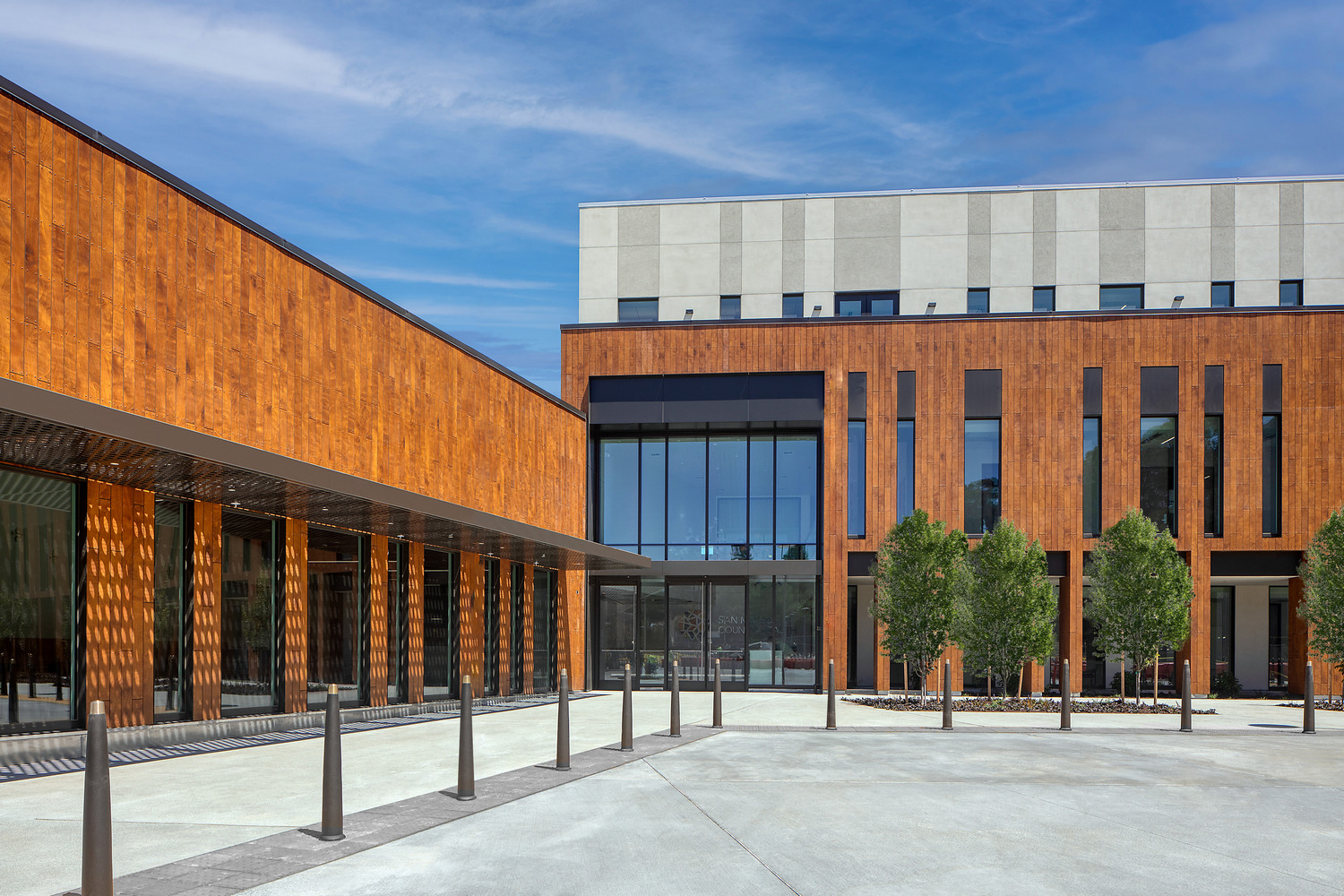
A ribbon-cutting ceremony celebrated the opening of San Mateo Medical Center’s refreshed campus. Located in San Mateo, California, the project included renovation of 200,000 square feet of the campus; it was nearly a decade-long-transformation project that began with a master plan in 2016. Key components of the project include facility upgrades, the addition of a new administration building and an enhanced hospital entry experience known as the Link Building.
The project was driven largely by the recognition that one of the older hospital buildings on campus — dubbed the “1954 Building”— would require a massive overhaul by 2030 to meet the seismic requirements of California’s Senate Bill 1953.
The redeveloped campus reflects San Mateo’s character. Building height, lighting and materials were considered to preserve neighborhood views and maintain a sense of warmth and approachability. The exterior design was inspired by the area’s redwood forests; the façade uses composite wood paneling and linear windows to create a tree-lined colonnade.
The administration building applies contemporary workplace principles, including open sightlines, abundant daylight, shared amenities and a signature central staircase. Several walls in open areas are coated with whiteboard paint, transforming them into collaborative surfaces. The goal was to encourage interaction, transparency and well-being among staff who had long
The Link Building creates a welcoming, unified entry to the campus, seamlessly connecting the hospital, administrative offices and community amenities. Previously, visitors parked behind the hospital and navigated back corridors to reach the lobby. The Link Building is an intuitive, light-filled entry that leads to a public café, gift shop and essential services.
Designed to serve as a community asset to the surrounding neighborhood, the new campus integrates green space, an exercise lawn and a walking path that circles the grounds, all accessible to the community. Outdoor seating and gardens provide moments of respite for patients, staff and neighbors.
To create an even stronger sense of place, the design team solicited local artists to contribute work. Sculptural and graphic installations by Bay Area artists — including Yellow Goat Design’s butterfly motif that greets visitors upon entry — bring color, movement and optimism.
Taylor Design served as the architect of record and provided master planning and interior design services. Additional project partners included: Perkins & Will, design architect, exterior; Truebeck Construction, general contractor; Simpson Gumpertz & Heger, structural engineer; Interface Engineering, MEP engineer and BKF Engineers, civil engineer.