By Rachel Windham
 Many older healthcare campuses and systems that have brought disparate, multiple facilities together as part of a single organization struggle to translate the best attributes of the brand identity into patient-friendly facilities. The concept of branding can be tricky, meaning different things to different people. Often “brand” is relegated to the marketing department to deal with visual imagery such as logos or what is referred to as “little b.” What is concerning in designing for the built environment, especially interior environments, is the entire experience of place — all of the details that touch the senses and express the values of the brand, or the “big B.”
There are few places where this brand experience is more important than in hospitals, where the perception of the healthcare environment on the part of patients and their families has the potential to affect a sense of the quality of care. At the same time, healthcare environments present an experiential challenge because of several touch points on the patient’s journey through the brand.
From first impressions upon arrival to clinical care, the process of being a patient influences the perception of the experience, be it positive or negative. The more a hospital can control and shape the experience, the greater the impact on the perception of the quality of care and the healthcare brand.
Working with Children’s Medical Center in Dallas on its complex, multi-building urban campus to create intuitive design strategies that will strengthen the brand, project team members developed an approach to branded interiors and intuitive design and wayfinding that readily translates to other organizations facing similar challenges. 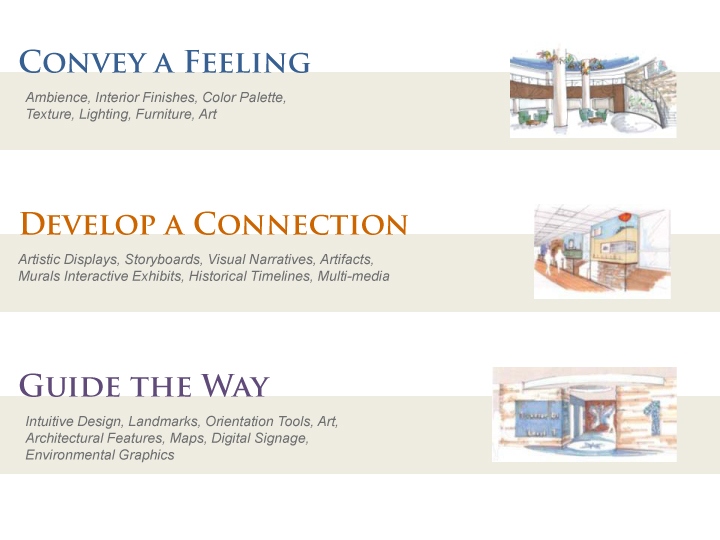 To overcome obstacles in the way of delivering a positive experience for patients and their families, the project was approached with a triad of guiding principles:
• Convey a feeling: ambience, interior finishes, color palette, texture, lighting, furniture and art;
• Develop a connection: artistic displays, storyboards, visual narrative, artifacts, murals, interactive exhibits, casino on line play pokies online for historical timelines and multi-media;
• Guide the way: intuitive design, landmarks, orientation tools, artwork and architectural features. This included maps, digital signage and environmental graphics.
The recommended discovery phase included an audit that features a review of plans and standards, photo documentation of the facilities and an onsite interview with both hospital personnel and patient families.
A vision session explored the brand attributes of the organization. This included everything kasyno from the brand lexicon (i.e., caring, experienced and innovative) to the tagline and brand messages. In addition, the design dialogue used built-environment imagery to visually capture the essential elements of the brand.
With findings from the discovery effort, the team was able to identify the areas in need of attention, (where are the disconnects? what’s inconsistent, non-intuitive or missing?) evaluate and prioritize conclusions. Priorities then determined the team was ready to develop specific strategy solutions across the touch points on the patient’s path through the environment. These touch points can be as simple as minimizing visual clutter or as complex as creating a more intuitive wayfinding system that guides patients and visitors from the parking structure to treatments areas.
One of the most important lessons learned in developing the approach is the team revolved around designing for people at their most emotional and vulnerable; design must combat fear and worry. In addition, it must be attractive and comfortable, create obvious public pathways and spaces and promote positivity and healing.
This approach has great potential as healthcare organizations work to adapt existing facilities to the demands of a patient population where perception and experience play an increasing role in healing and satisfaction.
Rachel Windham is an associate at WHR Architects and has 12 years of healthcare interior design experience. Her background includes all aspects of interior design with a special focus on intuitive design and wayfinding. She is a Registered Interior Designer, LEED-accredited professional and an active member of the International Interior Design Association and the Society for Environmental Graphic Design.